The challenge
The bench’s mechanical structure, some components and earlier technical material were already available. What was missing was the system needed to turn that foundation into a testing machine that could be controlled, measured and operated through a structured process.
The goal was to test conveyor belts under controlled speed, tension and opposing torque, acquiring and recording the machine’s key measurements.
This meant integrating the main motor, two tensioning actuators, position and load sensors, torque measurement, a pneumatic brake, industrial I/O and devices with different interfaces, with clear responsibilities for control, safety, supervision and diagnostics.
I took responsibility for the entire electrical, electronic, embedded and software chain needed to turn the existing structure into an integrated test system.
From field to data
The scope covered system architecture, the control cabinet, safety circuits and interlocks, sensors and drives, real-time firmware, industrial communications, edge software, data acquisition, HMI, bring-up and commissioning.
I also handled component selection and sizing, procurement, supplier coordination and technical documentation.
Electrical and machine integration
I designed the control cabinet, 400 VAC / 24 VDC power distribution, protections, I/O, sensor integration and drive interfaces.
The safety chain operates independently of the software layers: emergency stop, interlocks and inverter safety functions act through the electrical circuit, while the controller reads their status for diagnostics.
The measurement chains — LVDTs, load cells and torque sensor — were integrated and calibrated to turn physical signals into quantities the rest of the system could use.
Embedded control
The embedded controller handles the tensioning slide’s real-time functions: feedback acquisition, PWM, closed-loop control, homing, realignment, limits and faults.
Each side has an independent actuator and separate feedback, allowing the controller to account for misalignment as well as position.
State machines, watchdogs and checks for abnormal conditions keep these functions close to the machine and independent of supervision.
Edge and data
The edge layer integrates the controller, inverter, I/O, sensors and brake through RS-232, RS-485, Modbus and dedicated protocols.
The backend converts readings into physical units and handles commands, APIs, real-time telemetry, diagnostics, logging and time-series recording.
Timeouts, ACK/NACK, connection status and data freshness help distinguish communication issues from device or control faults.
HMI
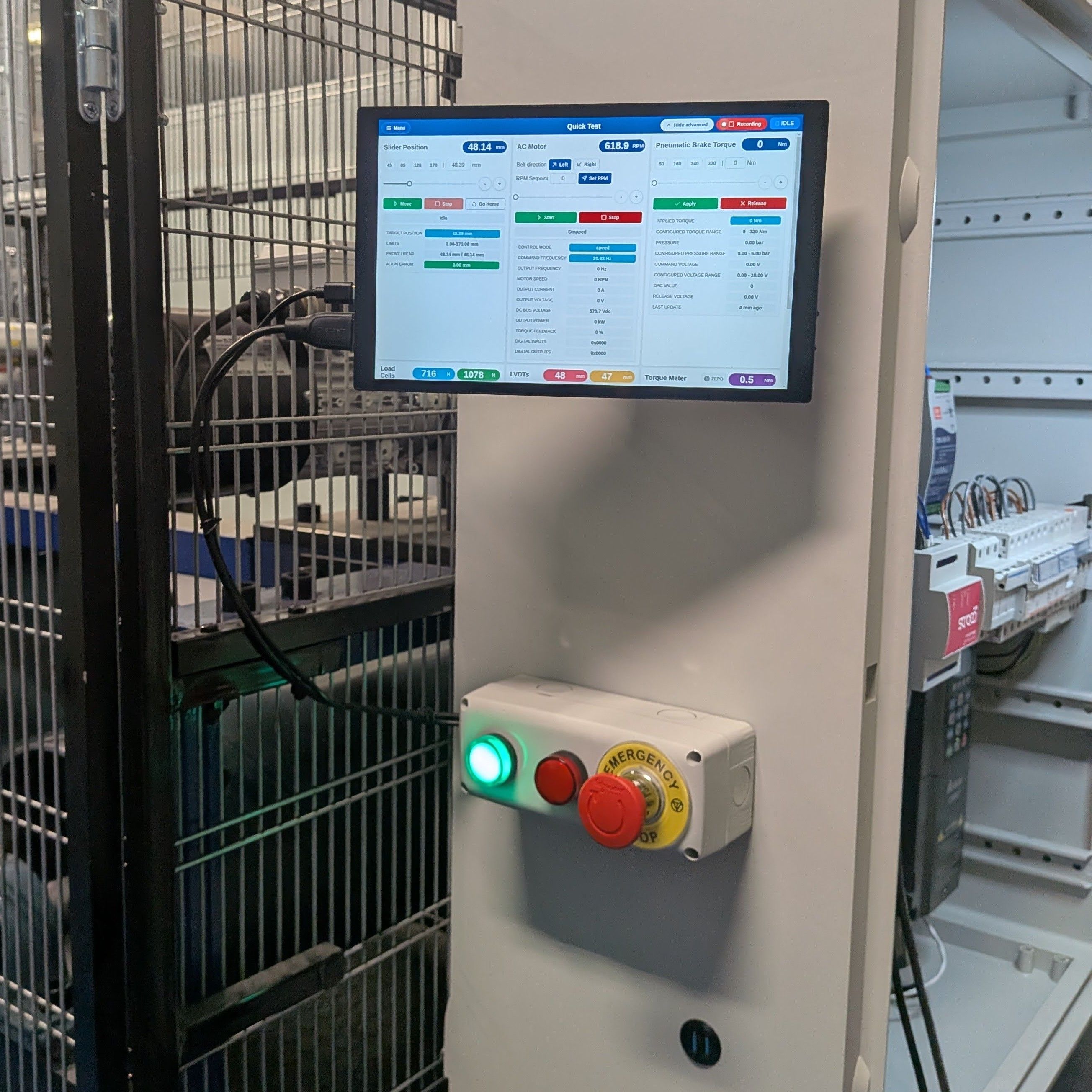
The operator interface brings commands, measurements and diagnostics together in a consistent view of the machine.
It lets the operator control subsystems, observe position, load and torque, monitor a test and record data without needing to understand the underlying implementation.
A quick-control mode supports bring-up and diagnostics, alongside guided workflows for test configuration.
Three design decisions
Two actuators, one motion
The same command does not necessarily produce the same response on both sides of the slide.
The controller therefore uses independent feedback and explicitly accounts for misalignment.
Decision: treat the two channels as distinct physical systems to coordinate, rather than theoretically identical actuators.
Fault-tolerant communications
Devices and controllers communicate over different links and protocols, each with its own failure modes.
Timeouts, ACK/NACK, connection status and diagnostics help locate the source of a problem rather than reduce it to a generic communication error.
Decision: design behaviour under fault conditions as well as during normal operation.
Safety independent of supervision
The interface must let the operator control and understand the machine, while critical functions remain independent of the browser, edge computer and communications.
Decision: keep control and protection at the appropriate layer, using supervision to coordinate, observe and diagnose.
Bring-up and commissioning
Integration progressed through power and signals, individual devices, actuators, sensors, communications, coordinated control and finally supervision.
This approach made it easier to isolate differences between the two motors, measurement noise, communication issues and integration anomalies.
Calibration and characterization included separate calibration of the two load cells and characterization of the pneumatic brake.
Bring-up was part of the design process, rather than a check left until the end.
The outcome
An existing mechanical structure became an integrated test bench capable of controlling belt tension, speed and opposing load, acquiring key physical measurements and retaining data and diagnostics.
The operator has a single supervisory interface to command the machine, follow its behaviour and analyse recordings, while real-time control and safety functions remain separate from the higher software layers.
The same infrastructure supports testing, commissioning and troubleshooting, making it easier to distinguish machine, measurement, control, communication and software issues.
The value of this project lies in treating electrical systems, electronics, firmware, communications and software as parts of the same problem, delivering a controllable, observable and traceable system.
Technologies
Electrical & sensing
Control cabinet · 400 VAC / 24 VDC · Protections & interlocks · Safety circuit · Signal conditioning · LVDT · Load cells · Torque measurement · VFD · Pneumatic brake
Embedded & control
C / C++ · FreeRTOS · Real-time firmware · Closed-loop control · PID · State machines · PWM · ADC · Watchdog · Fault handling
Industrial communication
UART · RS-232 · RS-485 · Modbus · Proprietary serial protocol · Industrial I/O · VFD integration
Edge & backend
Embedded Linux · Raspberry Pi · Node.js · TypeScript · NestJS · REST APIs · WebSocket / Socket.IO · Structured logging
Data & HMI
InfluxDB · Grafana · Time-series data · Real-time telemetry · Vue 3 · Pinia · Chart.js · Guided workflows
Integration & validation
System architecture · HW/FW/SW integration · Bring-up · Sensor calibration · Experimental characterization · Diagnostics · Troubleshooting · Commissioning · Supplier coordination